
Coconut Charcoal Export Documents: A Complete Guide for International Buyers
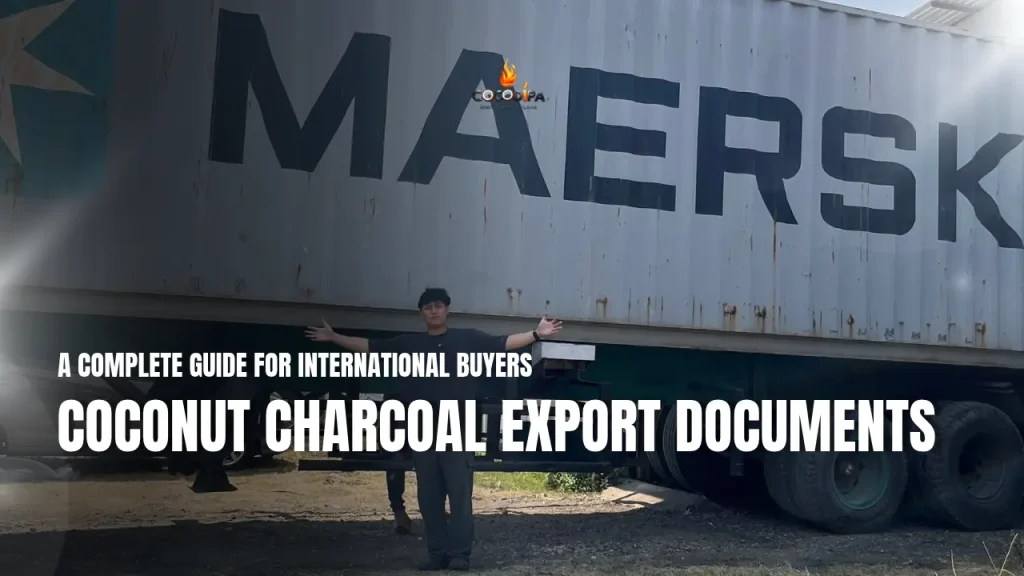
Understanding coconut charcoal export documents is essential for international buyers planning to import coconut shell charcoal briquettes from Indonesia.
Whether you are an importer, wholesaler, distributor, or shisha charcoal brand owner, preparing the correct export documentation helps ensure smoother customs clearance and international shipping.
The required documents depend on the destination country, product specifications, shipping method, and carrier requirements.
In this guide, KOKODIBA explains the main documents involved in exporting coconut charcoal from Indonesia.
1. Commercial Invoice
A Commercial Invoice is a primary document in international trade, issued by the exporter to the buyer.
It contains important transaction information, including:
- Exporter and importer details.
- Product description.
- HS Code.
- Quantity and unit price.
- Total shipment value.
- Country of origin.
- Payment terms and Incoterms.
For coconut charcoal, the product description should accurately identify the cargo, such as Coconut Shell Charcoal Briquettes for Shisha Use.
2. Packing List
A Packing List provides detailed information about the shipment’s packaging and weight.
It generally includes:
- Number of cartons or packages.
- Net weight and gross weight.
- Packaging type.
- Product dimensions.
- Package marks and numbers.
For example, a shipment packed in 1 kg inner boxes and 10 kg master cartons should clearly state the packaging configuration and total quantity.
3. Bill of Lading (B/L)
The Bill of Lading is issued by the shipping line or its authorized agent after the cargo is accepted for shipment.
It serves as evidence of the contract of carriage and receipt of goods.
Important details include the shipper, consignee, port of loading, port of discharge, cargo description, container number, and gross weight.
For charcoal shipments, cargo descriptions and dangerous goods information must comply with the carrier’s requirements.
4.Export Customs Declaration (PEB and NPE)
PEB (Pemberitahuan Ekspor Barang) is the Indonesian export customs declaration submitted to the Directorate General of Customs and Excise.
It is used to declare goods being exported from Indonesia.
After the export customs requirements are fulfilled, the relevant customs process results in the issuance of NPE (Nota Pelayanan Ekspor).
These documents are part of the Indonesian export customs procedure and are generally handled by the exporter or an authorized customs service provider (PPJK).
5. Certificate of Origin (COO)
A Certificate of Origin identifies the country where the exported product originates.
For coconut shell charcoal manufactured in Indonesia, a COO may be requested by the buyer or destination-country customs authorities.
It can also be important when an importer wants to benefit from preferential import duties under applicable trade agreements.
Whether a COO is required depends on the destination country’s regulations and the applicable trade arrangements.
6. Certificate of Analysis (COA)
A Certificate of Analysis provides technical information about the product’s quality and composition.
For coconut shell shisha charcoal, buyers commonly request information about:
- Ash content.
- Moisture content.
- Fixed carbon.
- Volatile matter.
A COA helps importers verify whether the product meets their agreed purchasing specifications.
For better traceability, the report should represent the actual tested product or batch.
7. Safety Data Sheet (SDS/MSDS)
An SDS, formerly commonly called MSDS, provides information about product hazards, safe handling, storage, and transportation.
It is particularly important for coconut charcoal shipments because certain charcoal cargoes may be regulated as dangerous goods during sea transportation.
Shipping lines may request an SDS/MSDS before approving a charcoal shipment.
The document must accurately describe the actual cargo and its applicable transport classification.
8. Dangerous Goods Declaration (DGD)
Coconut charcoal can be subject to dangerous goods regulations because of its potential for self-heating.
Depending on the actual cargo classification, shipping documentation may involve:
- UN Number: UN 1361.
- Proper Shipping Name: CARBON.
- Hazard Class: 4.2.
A Dangerous Goods Declaration provides the carrier with the required information about the dangerous goods being transported.
The classification must be verified for the actual product under applicable maritime regulations. Not every charcoal product should automatically be assigned the same classification.
9. Weathering Certificate and Vanning Certificate
Some shipping lines require additional documentation for charcoal cargo before accepting a booking.
Weathering Certificate
This document provides evidence of the weathering process after charcoal production. It may include production dates, weathering periods, packaging dates, and manufacturer details.
Vanning Certificate
This document or survey report provides information about the container stuffing process, including container condition, cargo arrangement, and loading details.
Requirements vary between shipping lines and should be confirmed before shipment.
10. Are Phytosanitary and Fumigation Certificates Required?
Not necessarily.
Processed coconut charcoal briquettes should not automatically be assumed to require a Phytosanitary Certificate.
The requirement depends on the destination country’s regulations, product classification, and packaging materials.
Importers should confirm whether phytosanitary, fumigation, or other quarantine-related documents are required before arranging shipment.
11. Coconut Charcoal Export Documents Checklist
Here is a practical checklist for exporters and international buyers.
| Document | Main Purpose |
|---|---|
| Commercial Invoice | Commercial transaction details |
| Packing List | Packaging and weight details |
| Bill of Lading | Sea transportation document |
| PEB and NPE | Indonesian export customs |
| Certificate of Origin | Country of origin |
| Certificate of Analysis | Product quality |
| SDS/MSDS | Safety and handling information |
| DGD | Dangerous goods declaration |
| Weathering Certificate | Weathering process evidence |
| Vanning Certificate | Container loading inspection |
Not all documents are mandatory for every shipment. Requirements should always be confirmed with the shipping line, customs broker, and destination-country authorities.
Frequently Asked Questions (FAQ)
1. What documents are required to export coconut charcoal from Indonesia?
Common documents include a Commercial Invoice, Packing List, Bill of Lading, PEB, and relevant certificates. Depending on the cargo and shipping line, SDS/MSDS, DGD, Weathering Certificate, and other dangerous goods documents may also be required.
2. Is coconut charcoal classified as dangerous goods?
Certain coconut charcoal shipments are regulated as dangerous goods because of their potential for spontaneous combustion or self-heating. The actual classification must be confirmed according to applicable regulations.
3. What is UN 1361 in charcoal shipping?
UN 1361 refers to CARBON, Class 4.2, substances liable to spontaneous combustion. Its application must be verified for the actual cargo.
4. Is a Certificate of Origin mandatory?
Not for every shipment. It depends on the destination country’s import regulations and whether the buyer needs preferential tariff treatment.
5. Can all shipping lines accept coconut charcoal?
No. Shipping line acceptance varies. Some carriers restrict charcoal cargo, while others accept it under specific documentation, packaging, and handling requirements.
6. Who prepares coconut charcoal export documents?
The exporter generally prepares commercial documents, while customs declarations, certificates, laboratory reports, and dangerous goods documents are handled by their respective responsible parties.
Conclusion
Preparing the correct coconut charcoal export documents is an important part of successful international trade.
From commercial invoices and packing lists to dangerous goods declarations and shipping certificates, every document has a specific role in ensuring that coconut charcoal shipments comply with applicable export and transportation requirements.
For international buyers, working with an experienced exporter who understands product specifications, export documentation, and shipping procedures can make the importing process more organized.
Looking for a Coconut Shell Shisha Charcoal Supplier from Indonesia?
Cocodipa supports international B2B buyers with coconut shell shisha charcoal, product specifications, packaging solutions, and export coordination.
Contact KOKODIBA to discuss wholesale orders, private label requirements, and export opportunities.
Cocodipa— Premium Coconut Shell Shisha Charcoal from Indonesia.
